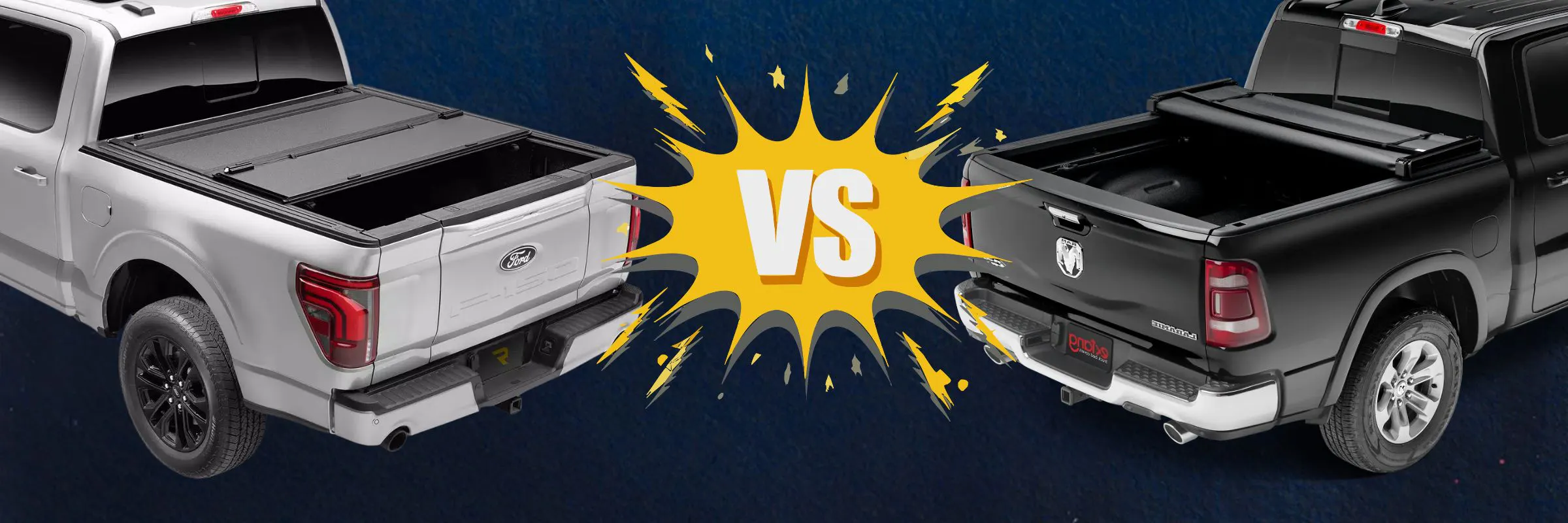
Hard Folding vs Soft Folding Tonneau Cover: Which One Should You Get?
You’ve decided you want a folding tonneau cover. Good call — folding covers are the most popular style on the market because they give you easy bed access without giving up protection. But now you’ve got another decision: hard folding or soft folding?
They look similar from a distance and they work the same way — two or three panels that fold toward the cab. But the materials, the protection level, and the price gap between them are real. Here’s the honest breakdown so you can figure out which one makes sense for your truck and how you use it.
What’s Actually Different?
Both styles use a tri-fold (sometimes quad-fold) design. Both clamp onto your bed rails with no drilling. Both fold up toward the cab for bed access. The difference is what the panels are made of.
Hard folding covers use rigid panels — typically aluminum or fiberglass-reinforced polymer (FRP). These panels are solid. They can take a snow load. You can’t cut through them with a knife. They’re built to last as long as your truck if you take care of them.
Soft folding covers use marine-grade vinyl stretched over a lightweight aluminum frame. The frame gives the cover its shape, but the top surface is fabric. It’s lighter, simpler, and more affordable — but it’s not going to stop someone with a box cutter.
That material difference is where everything else flows from: security, weather protection, weight capacity, durability, and cost.
Security
This is the biggest gap between the two.
A hard folding cover locks automatically when your tailgate is closed and locked. The rigid panels can’t be slashed, pried, or peeled back. Someone would need tools and time to get through one — which is a strong deterrent in a parking lot or job site.
A soft folding cover keeps your cargo out of sight, and that’s worth something. Most casual theft is opportunistic — someone walks by, sees a tool bag in the bed, and grabs it. A soft cover eliminates that. But the vinyl can be cut in seconds, so it won’t stop a determined thief.
Bottom line: If you carry tools, equipment, or anything valuable in your bed regularly, go hard folding. If you just want to keep honest people honest and your cargo dry, a soft folder does the job.
Weather Protection
Hard folding covers seal tighter. The rigid panels sit flush against rubber gaskets and EPDM seals around the bed rails and tailgate. In BC weather — and we get plenty of rain in the Fraser Valley — a hard folding cover keeps the bed dry in most rain condition you’ll get in the Fraser Valle. Most quality hard folders also include drain tubes that channel any water that does get past the seals out through the bed rails.
Soft folding covers are water-resistant as well, vinyl sheds rain well, but the seal points where the panels meet and along the side rails can let moisture in during heavy or sustained rain. You’ll probably see a few drops near the tailgate after a real downpour.
For snow, the hard cover wins easily. Rigid panels handle snow load without sagging. Vinyl panels can pool and sag under heavy wet snow, which puts stress on the frame and sags the vinyl overtime if not cleared of right away.
Bottom line: If your truck lives outside year-round in the Fraser Valley, a hard folding cover will protect your cargo better through the rain, snow, and freeze-thaw cycles we deal with here.
Weight Capacity
This is one that surprises a lot of people. Most hard folding covers can support 300 to 500 lbs of evenly distributed weight on top. That means you can set a cooler, a bag of gear, or even use the closed cover as a flat work surface at a job site. Some guys use it as a tailgate table at campgrounds.
Soft folding covers can handle maybe 20 to 30 lbs on top. Essentially, don’t put anything on them. The vinyl will sag and the frame isn’t built to bear weight.
Bottom line: If you’d ever want to set something on top of your cover — even occasionally — hard folding is the only option.
Durability and Lifespan
A quality hard folding cover like the BAKFlip MX4 is built to last the life of the truck. The aluminum panels resist corrosion, the matte black finish handles UV without fading, and the hinges are engineered for thousands of open-close cycles. FRP (fiberglass-reinforced polymer) panels are even tougher — more resistant to dents from hail or falling branches.
A soft folding cover will give you a solid 3 to 5 years with proper care. UV protectant spray helps extend the life of the vinyl, but it will eventually fade, dry out, or crack — especially if the truck sits outside. The aluminum frame itself holds up well, but the fabric is the weak link over time.
Bottom line: Hard folding covers are a long-term investment. Soft folding covers are solid for a few years but will need replacing eventually.
Ease of Use
Both styles operate the same way: unlatch, fold, done. Soft folding covers are lighter, so the panels are easier to flip. Hard folding covers are heavier per panel, but still made of lightweight material and have been upgraded so they don’t get water logged like the old hard folding panels.
Both can be folded with one or two panels up for partial bed access, but only the hard covers fold all panels up for full access. The folded panels rest against the rear window when fully open — which means they’ll block your rearview mirror while open. That’s fine for loading and unloading, but keep it in mind if you plan to drive with the cover open.
One area where soft folding covers have a clear edge: full removal. If you need a completely clear bed, a soft tri-fold comes off in minutes and leaves nothing behind. Hard folding covers can be removed too, but the side rails stay on the truck — so you've still got hardware in the bed when you need it clear.
Bottom line: This is where the soft folder shines. Both are easy to use. Soft folders are a bit lighter to handle, and are easily removable and storable.
Who Should Get Which?
Go Hard Folding If You:
• Carry valuable tools or equipment and need real security
• Want the cover to last as long as the truck
• Want to use the cover as a flat surface when closed
• Park outside year-round and need solid weather protection
• Need a low profile option to add racks or accessories later
• Want the cleanest, most premium look on your truck
Go Soft Folding If You:
• Want basic cargo protection on a tighter budget
• Don’t carry high-value items in the bed regularly
• Want the lightest, simplest cover available
• Are trying out a tonneau cover for the first time and might upgrade later
• Need something easy to remove completely when hauling tall loads
“Hard folding covers typically run $1,100 – $1600 CAD installed, while soft folding covers start around $500 CAD”
What About Soft Rolling?
If you’re looking at soft folding covers, it’s also worth considering a soft rolling cover. Soft rolling covers are in a similar price range but keep more of the features that matter — like a lower profile, locking with tailgate, and full bed access without folded panels blocking your rearview mirror. They roll up toward the cab instead of folding, which some truck owners find more convenient for frequent loading and unloading.
We carry soft rolling options from TruXedo and Extang. Check out our soft rolling tonneau covers page to compare.
A note on Installation
Both hard folding and soft folding covers install in about an hour at our shop. No drilling, no modifications to your truck. The difference is that getting the install right matters more on a hard folding cover — the rails need to be perfectly flush with the bed caps, the clamps torqued properly, and the seal tested against the tailgate. If any of that is off, you get leaks, rattles, or a cover that won’t latch cleanly.
That’s why we recommend professional installation. You can order a cover online and bolt it on yourself, but you won’t get the seal check, tension adjustment, and fitment verification that comes with having it done by someone who installs these every day. And if something needs adjustment down the road, you’re not shipping a box — you’re bringing your truck to us.
Frequently Asked Questions
Can I switch from a soft folding cover to a hard folding cover later? Yes. Both use the same clamp-on rail system. You’d remove the soft cover and install the hard one — it’s a straightforward swap. A lot of our customers start with a soft folder and upgrade after a year or two.
Which tonneau cover is best for a Ford F-150? Both hard and soft folding covers are available for every current F-150 model. The BAKFlip MX4 (hard folding) is our most popular cover for F-150s. For a budget option, the Extang Trifecta 2.0 (soft folding) or TruXedo Lo Pro (soft rolling) are solid choices.
Do folding tonneau covers improve fuel economy? A closed tonneau cover reduces aerodynamic drag at highway speeds, which can help with fuel economy. Hard folding covers sit slightly more flush and may provide a marginal edge, but both styles offer an improvement over an open bed.
Will a tonneau cover fit with my spray-in bedliner? Yes. Tonneau covers mount to the bed rails, not the bed floor. A spray-in liner won’t interfere with the install. In fact, we install a lot of tonneau covers and bedliners together as part of our New Truck Package.
Can I see both types in person before I decide? Absolutely. Stop by our shop at 44408 Yale Rd W in Chilliwack and we’ll show you both styles, walk through the differences, and help you figure out which one fits your truck and your needs. Give us a call to make sure we’ve got your model in stock.
Ready to Get Your Tonneau Cover Installed?
Trademasters is the Fraser Valley’s truck accessory shop. We carry hard folding and soft folding tonneau covers from BAKFlip, Extang, UnderCover, Rough Country, and more — all professionally installed at our Chilliwack shop. Whether you know exactly what you want or you’re still deciding, we’ll get you the right cover for your truck.
Browse our hard folding tonneau covers or soft folding tonneau covers online, or call us at to book your install.